


This is one of a series of short stories from a small community trying to live well in 2037.
The Place
Cuttawah sits on the southeastern coast of Australia, where the escarpment comes down to meet the sea. The Yuin people have lived along this coast for tens of thousands of years. European settlers arrived in the mid-nineteenth century, cleared the land for dairy farming, and named the town.
The town has about eight hundred permanent residents and swells during the holiday periods. For the past six years or so, the people who live here have been working out how to stay. Things are getting harder everywhere. This community stepped into that difficulty together and started building something. They don’t have a name for what it is.
Most of us know what it feels like to say the wrong thing and to wake up the next morning still carrying it. In Cuttawah, the community's decision-making process can't move forward while harm between two people sits unrepaired. It’s not a formal rule, it is what becomes true when the process is actually working.
The noticeboard outside the old supermarket still had Monday’s flyer pinned up, curling slightly at one corner where the staple had given way. FINDING NEW GROUND: BUSHFIRE READINESS, MEETING 4, it said, with the date and the time and nothing at all about what had actually happened in that room.
Mariana stood in front of it longer than she meant to. Four meetings. She did the maths without wanting to, two and a half hours each, near enough, plus the one that ran past eleven, and felt the total settle somewhere behind her ribs. All those hours the room had spent getting people to a place where nobody walked out outvoted, and how little of that she had managed to hold onto by hour four.
The cold found her properly then, the way it had not on the walk over. It went straight through her coat, down into her spine; the kind of cold that has nothing to do with the actual temperature and everything to do with what you are remembering while it lands on you.
She kept walking.
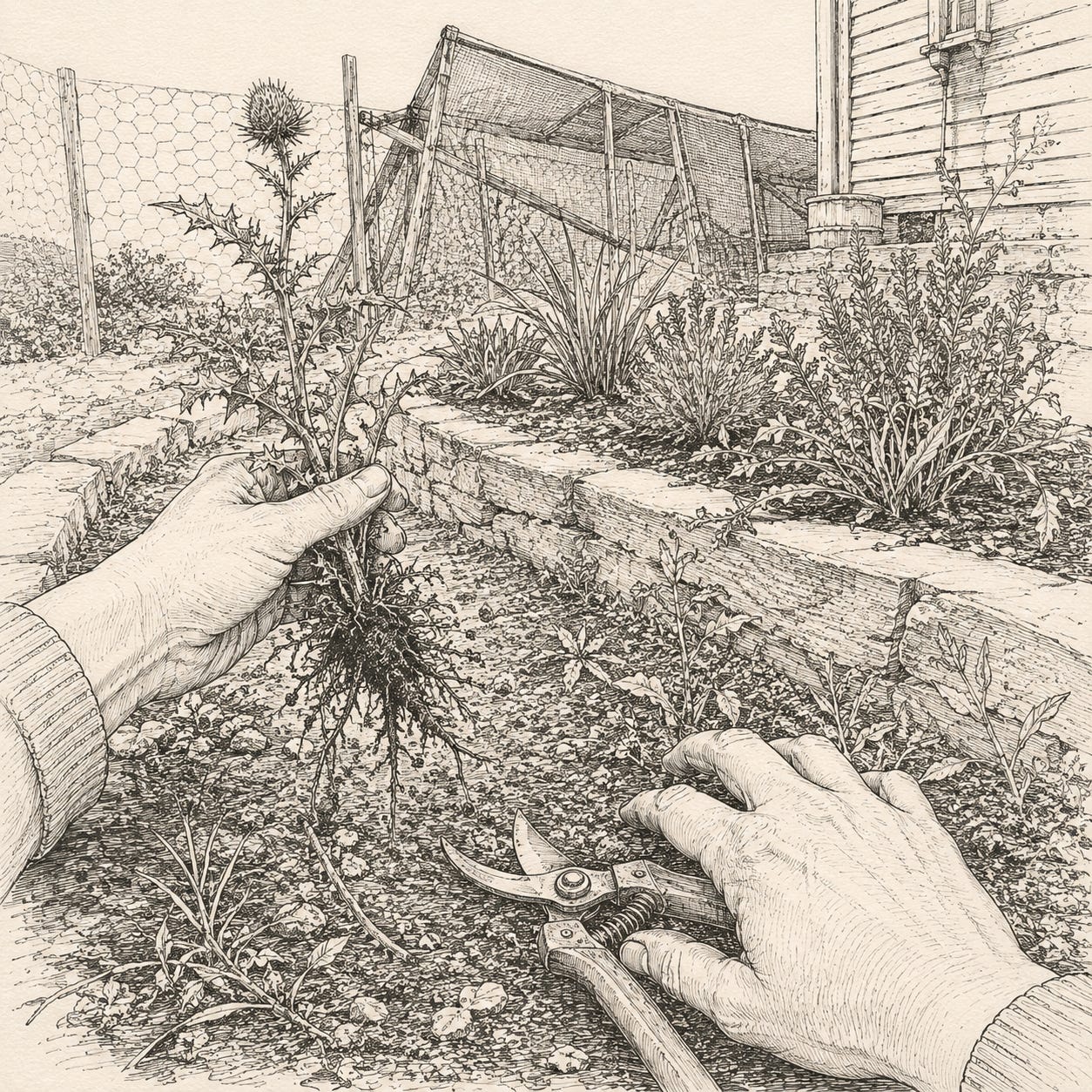
The Bush Food Garden, officially the Tattersalls Foundation Native Foods Garden, though nobody had called it that since the sign went up and most people suspected nobody ever would, sat behind the old butter factory. Three terraced beds, a shade house, a falling-down chook pen nobody had gotten around to fixing. Mariana let herself in through the side gate. She had brought the thermos out unopened and it sat on the edge of the raised bed, lid screwed on tight, doing nothing for anyone.
She worked along the warrigal greens, pulling out whatever was not warrigal greens. Winter weeds were sparse this time of year, but stubborn, the deep-rooted ones that had decided, against all reasonable seasonal logic, that this was their moment to show up. Her hands knew the difference between something that would come cleanly and something that would fight her. This morning she went looking for the ones that would fight.
A thistle, low and vicious, was hidden under a leaf twice its size. She got two fingers around the base and pulled. It did not come. She pulled harder, felt the small tear of root somewhere underground giving way, and there, in the half-second between effort and release, was Monday night.
Graeme had said the thing about volunteer hours being finite first, the way he always did, just put it plainly so nobody else had to be the one to say triage out loud. David, sixty-something David, who owned four houses he rented to people who came for a fortnight every January and never once in July, had said something about not wanting blood on his hands, about needing the brigade to commit to defending every property that paid its rates. His voice had done the thing voices do when a man is frightened and does not have the words for frightened, so it comes out as something closer to entitlement.
And Mariana had felt the old heat come up through her sternum, the specific heat of I have done the work and you have not, and she had said it flat, almost bored, like she was reading out a fact rather than aiming a blow: “Maybe if your kids actually wanted to be near you, you’d have help defending your own places.”
The thistle root let go all at once. She nearly overbalanced.
Diane’s hand had gone up first, not pointing, just rising the way it did. We don’t do that here. It was not unkind, almost gentle, which had somehow been worse.
Then Graeme, who had been running the meeting all night with the particular tirelessness of a man who had done this before and would do it again, "Let's stop here a minute," in a voice that was not asking permission. Chairs scraped back. Someone went to refill the urn without being asked. Nobody looked at Mariana, which was somehow worse than if they had.
When the room came back, Graeme did not go straight to the agenda. He looked at her, and then at David, and said, “Do you two want to sit with this now, while we’re all here? We can hold the space for it.”
It was a real offer. She had understood that even then, underneath the heat still sitting in her chest. The room would have stayed. David would have said something, probably something stiff and furious and true. She might have said something back that actually meant sorry, instead of the thing she had said instead.
“No,” she had said. “I’m fine.”
She was not asked again. That was its own kind of mercy, and she had hated it.
She had crossed her arms and looked at the laminate table for the rest of the meeting, while the room worked its way toward something like a plan: defend the town centre and the two roads in, let the outlying shacks take their chances this year, and get word to absentee owners that this was finally the season to believe the warnings.
She had nodded along to all of it from somewhere behind her own face.
“That one giving you trouble?”
Mariana looked up. Diane was two beds over, secateurs in one hand, not really pruning anything, as there was not much worth pruning in July. She had come in through the side gate at some point without Mariana hearing her, which Mariana supposed she should have expected.
“It came eventually,” Mariana said, and held up the thistle, root and all, as evidence of something.
Diane looked at it the way she looked at most things: without hurry. “Mm,” she said. “They do, in the end.”
Neither of them said anything else for a while. Mariana went back to the bed. Diane went back to not-pruning the dianella along the fence line.
It was Diane who broke it eventually, sideways, the way she did most things.
“David’s roof’s needed doing for years,” she said, to no one in particular. “Ron Castles was meant to get to it before he died. Never did.”
Mariana’s hands stilled on the next weed.
“He’s not wrong about the houses,” Diane went on. “If they go up, that’s his whole...” she made a small gesture, encompassing without specifying. “He’s not building anything else at his age. You know that.”
“I know that.”
“And he said it ugly. Wanting the brigade to promise something they haven’t got the bodies to promise.” Diane shrugged, economical. “Fear does that to a voice. Comes out the wrong door.”
Mariana pulled another weed. This one came easily, and she did not feel any better for it.
“What I said wasn’t about the houses,” she said.
“No.” Diane did not soften it, and did not sharpen it either. “It wasn’t.”
There was no comfort in the way she said it, and somehow that was the thing Mariana had been bracing against without knowing it. She had expected either absolution or a lecture, and Diane offered neither. She just set the plain shape of it down between them, like a tool returned to its place on the bench, with no fuss made of the returning.
“Graeme would have held it for you that night, you know,” Diane said, not unkindly. “Whole room right there. David too worked up to do much more than splutter at you, probably, and then it would’ve been said and done with.”
Mariana did not answer that.
“Now you’ve got to walk up his drive on your own. Knock. Stand there while he decides whether to let you say it.” Diane shrugged, the same economical shrug as before. “It’s a harder version, but the same job.”
Mariana sat back on her heels. Her knees, on the cold ground this long, had gone past uncomfortable into something that would ache properly by afternoon.
“I should go and see him.”
“You could.” Diane was already moving toward the compost bins, the conversation apparently concluded as far as she was concerned. “Or you ask me to hold a proper sit-down with the both of you, if you’re not ready to do it on your own legs yet. Either’s allowed.”
“Which would you do?”
Diane stopped at that, considered it with the same unhurried attention she gave the weeds, the roof, and Mariana’s knees. “I’d take him something,” she said at last. “Doesn’t fix the roof. But you don’t walk in empty-handed to a man who thinks he’s about to lose the last thing he’s got.”
She did not say what to bring. She did not need to.
“Graeme wants to call meeting five before the long weekend,” Diane added, almost as an afterthought, though Mariana doubted anything Diane said was really an afterthought. “Can’t ask everyone to agree on who’s defending what while this is still sitting between the two of you. It wouldn’t be fair to either of you, going in with it unfinished.”
It was not pressure, exactly. Diane did not say it like pressure. She said it the way she had mentioned the roof: just another true thing, lying there next to the rest of them, for Mariana to pick up or not.
She went back to the compost, and after a while Mariana heard the slow tumble of the bin turning, and under that the gulls going over toward the point, and under that, finally, something in her chest that had been clenched tight since Monday night loosening by some small unmeasured degree. It was not gone, just loose enough to stand, brush the dirt from her knees, and find out whether the coffee in the thermos was still worth drinking.
It was not, particularly.
She drank it anyway.
The moment between knowing and doing
Mariana knows what she needs to do before Diane says a word. That’s not the problem.
Most of us do. We know when we’ve caused harm. We know, roughly, what repair would look like. What gets in the way is rarely ignorance. It is the moment between knowing and doing, which can stretch out for days, or years, or a lifetime.
What Cuttawah has built is not a system that makes people better at knowing. It is one that makes the next action a little more available. The room holds the offer. The elder names the shape of it plainly. The path to the door is not cleared, exactly, but it is not blocked either.
The future has already arrived. It is just not evenly distributed.
Facilitated consensus processes, community fire preparedness, bush food gardens, and the idea that collective decisions cannot hold while unrepaired harm sits between people. None of this is invented. It all exists somewhere today.
We have everything we need.
Thank you for your support of The Art of Unravelling, I really appreciate you being here. I am keen to hear your thoughts on this place and what happens in it, I would like to know whether these images of 2037 help you face into the reality we find around us.
The Art of Unravelling is offered as a gift, sustained by those who feel called to support the weaving. If you’d like to help tend the fabric of this work, you can contribute via the link below.