


This is one of a series of short stories from a small community trying to live well in 2037.
The Place
Cuttawah sits on the southeastern coast of Australia, where the escarpment comes down to meet the sea. The Yuin people have lived along this coast for tens of thousands of years. European settlers arrived in the mid-nineteenth century, cleared the land for dairy farming, and named the town.
The town has about eight hundred permanent residents and swells during the holiday periods. For the past six years or so, the people who live here have been working out how to stay. Things are getting harder everywhere. This community stepped into that difficulty together and started building something. They don’t have a name for what it is.
On this ordinary Tuesday, a young farmer comes to sell his crop to the cooperative supermarket and finds out the cooperative doesn’t work that way.
Toby had practised the numbers in the ute on the way down, out loud, the way he had not practised anything since his Year 12 oral presentation, which Mrs Brandt had given him a B-minus for and a comment about speaking to the room, not the floor. He had not spoken to a room since. He had been speaking to cattle, mostly, and lately to a spreadsheet, and now apparently he was going to have to speak to Mrs Brandt herself, because someone had told him, with what he suspected was real cheerfulness, that she sat on the Purchasing Circle.
He came down off the escarpment the way he always did, across the bridge, the inlet opening up on his left with the campground beyond it and the mangroves thick along the tidal flat, thirteen years of growth doing what they were planted to do. The strip came up on his right as he crossed the bridge: the supermarket, a couple of cafes, the fish and chip shop, all of it facing the water it couldn’t quite see from here. The rest of the town was over the hill, tucked around the inlet, but you wouldn’t know it from this angle. You had to know it was there.
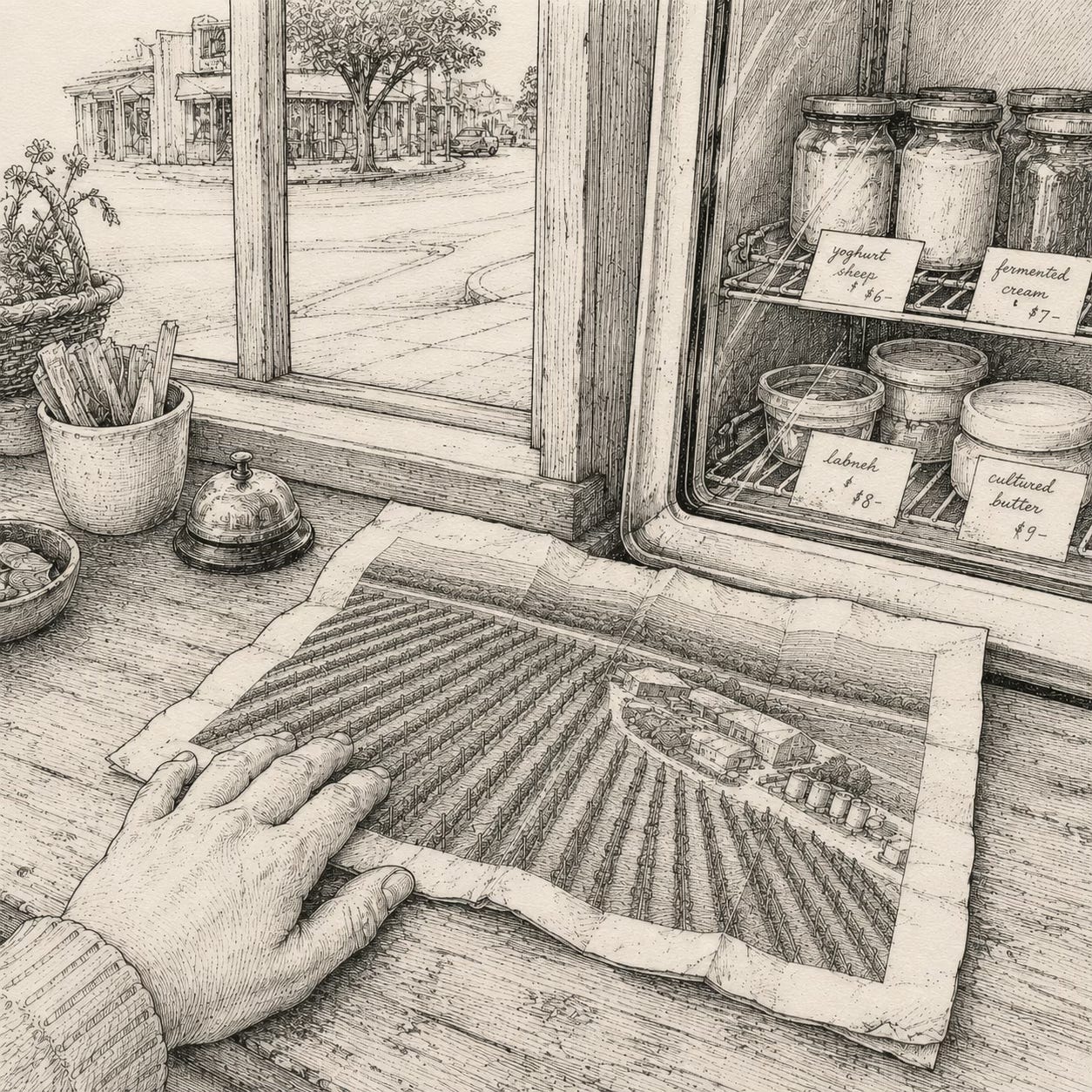
The printout in his good shirt pocket, already soft from being checked twice on the drive, detailed the estimated yield, both conservative and optimistic. It also included a drone photo of the trellis rows taken on Sunday, showing the plants just starting to set fruit, the small green berries barely visible against the foliage but there if you knew where to look. It was months off ripe, but you could already see the shape of the crop coming.
After three days of what still felt like unseasonable heat, the supermarket was a relief and it smelled like it always had, more or less: bread, and the particular cold breath from the dairy cabinet. The dairy cabinet itself, however, looked different to how he remembered it. It was less full, with more handwritten labels, and somebody’s name on a card under the yoghurt: Liesl’s. Mondays.
The woman at the front register clocked him before he had worked out who to ask for.
“You’ll be the muntries,” she said. It was not a question. She was already coming around the counter. “Toby, is it? I’m Mariana. I do Tuesdays.”
He had not told anyone his name was attached to muntries yet, as far as he knew, which meant someone already had. The size of the town had not changed, even if the supermarket had.
“I’ve got the numbers,” he said, and put the printout on the counter before she had asked for it, which he regretted as soon as he had done it. Mariana looked at it the way you would look at a kid showing you a school project: interested, unhurried, and in no rush to get to the part where she told him what was wrong with it.
“The drone shot’s good,” she said. “Tells me more than the spreadsheet does, honestly. How many plants?”
“Twenty five trellis rows. Four years in the ground. This is the first year I’d call a real crop. They’re running about six weeks early, so we are expecting fruit by Christmas if the weather holds.”
“And that works for you? Christmas trade?”
“That’s what I am hoping.”
“And the rest of it? You’ve still got the dairy contract?”
“Coles broke that up in thirty-two. I’m with Riverina Co-op now. It’s wholesale, decent enough, but the freight’s killing me even with the truck on ethanol credits. Forty minutes each way before I’ve even joined the highway.” He heard himself getting ahead of where she had asked him to go and made himself stop. “I just thought that with Christmas and the visitors, there would be a market for somebody local doing muntries instead of trucking dried berries up from God knows where.”
“It’s a good thought.” Mariana folded the printout closed, careful with it, the way you would close a book you meant to come back to. “Here’s the bit nobody tells you on the way in, though. We don’t buy off growers. Growers join, and then we buy off members.”
Something tightened in Toby’s chest.
“Join, like...”
“Like there’s a meeting. Like you’ll need to come to a couple of things before anyone here’s spending co-op money on a crop that’s still green on the trellis.” She said it plainly, the way she would say a fact about frost. “The Purchasing Circle meets on the first Wednesday of the month. So the next one is tomorrow, you’d want to come to that one before the fruit is properly on. It will give everyone time to get used to the idea of you, not just the idea of muntries.”
“Who’s on it?”
“Helen Brandt. Graeme, you would know him, probably; he is married to Sascha.” Mariana watched something cross his face and did not comment on it, which he appreciated more than he expected to. “And me, this quarter. We rotate.”
Mrs Brandt would read the yield estimates the way she’d read his assignments, looking for the working he hadn’t shown. And Graeme he’d met exactly twice, both times at things Sascha had organised, both times with that particular awareness of knowing exactly which two people in the room used to be something to each other.
“Right,” he said.
“It’s not as bad as your face is telling me it’s going to be.” Mariana almost smiled. “Helen marks hard. Always has. She’ll ask you what happens if the fruit comes in small, what happens if it splits before you pick, whether you’ve got a plan if half of it’s not gradeable. Have an answer. That’s all marking ever wanted from you, probably.”
Toby looked at the dairy cabinet again, at Liesl’s name on the yoghurt.
“And if they say yes?”
“Then it’s not ‘yes, we’ll take the lot.’ Not year one.” Mariana was matter-of-fact about this in a way that made it easier to hear than he had expected. “We’d do a trial. Small volume, see how it grades, see how it sells, see whether visitors actually want to pay what fresh muntries at Christmas are worth, because most of them have never seen one, let alone eaten one off the plant.” She paused. “If it goes well, you come back to the Circle in the new year and we talk about next season properly. Real numbers, not drone photos.”
“And the rest of the crop? If I’ve got more than a trial’s worth?”
Mariana considered this the way Toby imagined she considered most things: without any apparent urgency, but like she was actually doing the considering rather than performing it.
“Honesty box,” she said. “A trestle table at your gate, a scale, a tin. You’d be surprised how much of the district still runs on people doing the right thing when nobody’s watching, especially around Christmas when everyone’s feeling generous and a bit guilty about something.” She shrugged. “It doesn’t replace the co-op. But it’s not nothing, either, and it costs you a trestle table and an honest sign.”
Toby picked the printout back up off the counter, the soft, much-folded shape of it suddenly looking less like evidence and more like something he had been hiding behind.
“Dad never would have done any of this,” he said, not entirely meaning to say it out loud. “He’d have just trucked the lot to Riverina and taken whatever they gave him.”
“Probably.” Mariana did not make anything of it either way; no judgment on the father, no congratulation for the son. “There’s no wrong way to get fruit to people, Toby. There’s just the way that suits you, and the way that doesn’t anymore.”
He folded the printout once more, smaller this time, and put it back in his pocket.
“Tomorrow” he said.
“Tomorrow.” She was already moving back around the counter, toward whoever had just come in behind him. “Bring the drone photo. Brandt’ll like that you measured something properly, even if she pretends she doesn’t.”
Muntries (Kunzea pomifera) are a native Australian groundcover plant that produces small berries with a spicy apple flavour. They grow naturally along the southeastern coast of Australia and have been eaten by First Peoples for thousands of years. The berries are high in antioxidants, higher than blueberries by most measures, and have a long history as both food and medicine. Commercial cultivation is still relatively new, which makes them one of those ingredients that exists between the ancient and the experimental. Fresh muntries are only available for a short season so most people outside Australia, and many inside it, have never tasted one.
The future has already arrived, it is just not evenly distributed.
Consumer cooperatives, native food cultivation and farm-gate honesty boxes feature in this Tuesday. None of this is invented, it all exists somewhere today.
We have everything we need.
Thank you for your support of The Art of Unravelling, I really appreciate you being here. I am keen to hear your thoughts on this place and what happens in it, I would like to know whether these images of 2037 help you face into the reality we find around us.
The Art of Unravelling is offered as a gift, sustained by those who feel called to support the weaving. If you’d like to help tend the fabric of this work, you can contribute via the link below.
Well done. I am in for the journey.