

This is one of a series of short stories from a small community trying to live well in 2037.
The Place
Cuttawah sits on the southeastern coast of Australia, where the escarpment comes down to meet the sea. The Yuin people have lived along this coast for tens of thousands of years. European settlers arrived in the mid-nineteenth century, cleared the land for dairy farming, and named the town.
The town has about eight hundred permanent residents and swells during the holiday periods. For the past six years or so, the people who live here have been working out how to stay. Things are getting harder everywhere. This community stepped into that difficulty together and started building something. They don’t have a name for what it is.
This one is about what happens when something is returned broken.
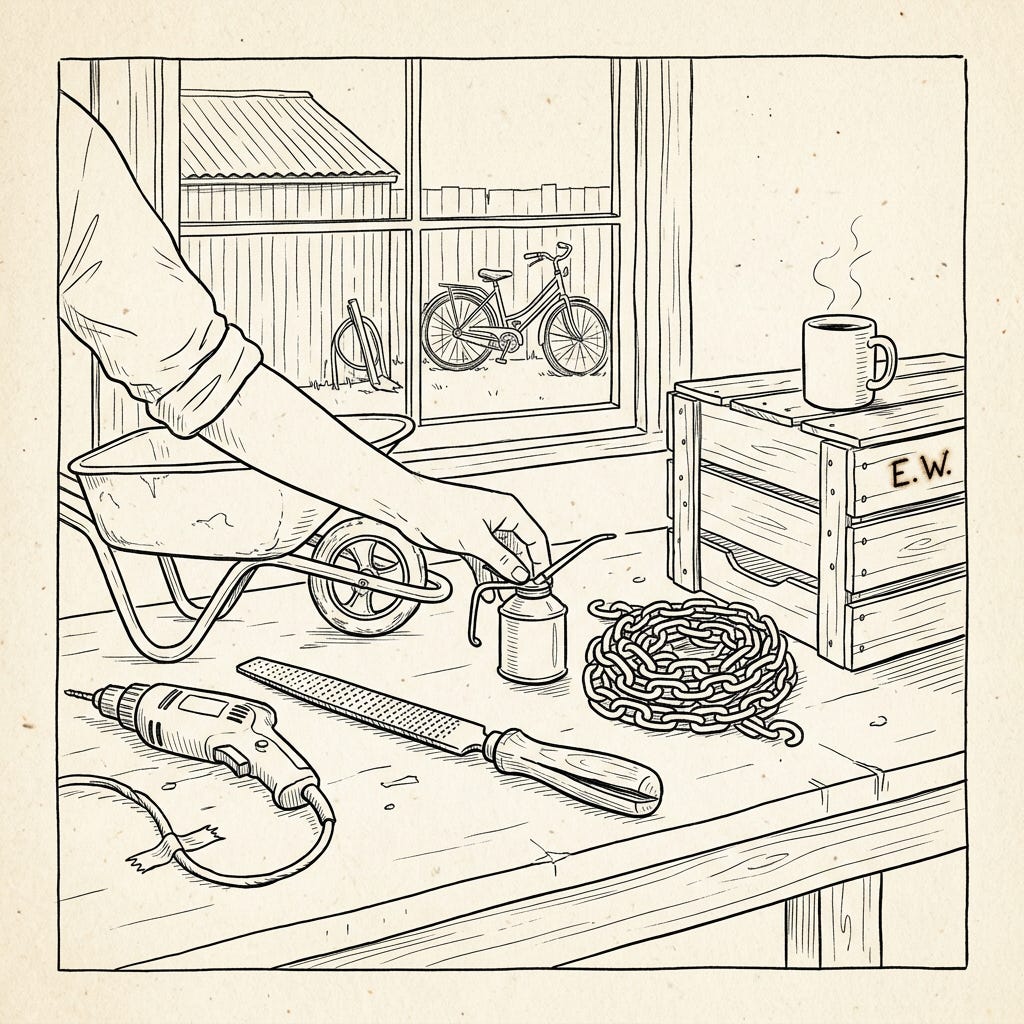
David was in the shed before seven, the way he always was, oiling the chain on the brush cutter nobody had asked him to oil. The tool library ran better if somebody just did the unglamorous maintenance without being rostered for it, and David had decided some years ago that the unglamorous maintenance might as well be the thing he was good at.
He heard the gate before he saw who it was. He knew it was Oscar Pham’s bike by the particular tick of the back wheel, a spoke gone slightly out of true, a tick he’d long associated with the boy’s arrivals and departures.
Oscar came in holding the rasp out in front of him the way you would hold something you were hoping might be forgiven before it was even properly looked at.
“It’s broken,” he said, by way of greeting.
David took it from him and turned it over once. The handle had split clean along the grain a hand’s width back from the tang. It was the kind of split that does not happen from ordinary use; somebody had given it a fair whack against something solid.
“Bench?” David asked, not looking up.
“Yeah.” Oscar’s ears had gone pink. “I was trying to get the sawdust out of the teeth. I might’ve hit it harder than...”
“Mm.” David set it on the bench under the window, the one reserved for things waiting their turn, next to a drill with a frayed cord and a wheelbarrow missing a tyre. He did not ask what Oscar had been frustrated about. He had learned, slowly, over years of running this shed, that the tool itself rarely had much to do with it. “The kettle’s just gone off. Sit down a minute.”
Oscar sat on the upturned crate that had been there as long as David could remember, the one with someone’s initials burned into the side from some long-forgotten working bee. He did not seem in any hurry to leave. David recognised the hesitation of a boy who had come with a purpose he hadn’t yet found the words for.
“How’s Denmarsh,” David said. It was not really a question.
Oscar shrugged with his whole upper body, the particular shrug of someone trying to compress a great deal into a small gesture. “It’s a school.”
“That bad?”
“It’s not bad.” He picked at a splinter on the crate’s edge. “On Wednesday, Mr Pavlou puts a kid’s woodwork project up the front of the room because it’s good. Within about ten seconds you can feel everyone deciding if that’s a problem for them or not, whether it makes theirs look worse.” He glanced up. “Nobody says anything. You can just feel the room doing it.”
“And here?”
Oscar thought about it properly, like he had not been asked to put it into words before. “Macca, who runs the bushcare crew on Thursdays, if somebody stuffs up a planting or snaps a tool or whatever, he just looks at what actually happened. Was the ground too hard, was the tool wrong for the job, did you not know yet? It stays about the thing. At Denmarsh it turns into something about you. Like it follows you around after.”
“Mm,” David said, which was as much agreement as he tended to give to anything out loud.
Oscar turned the tea in his hands without drinking it, working up to something.
“Is there boat work here? Actual work, not just mucking around.”
“Depends what you mean by work.”
“I don’t know. Building them. Fixing them. Whatever it is that means I don’t have to leave to do it.” He said it fast, like he had been holding the question a while and wanted it out before he lost his nerve. “Everyone talks about Garnock TAFE like it’s the only place that does boats properly. I just... I don’t actually want to go anywhere. I just didn’t think there was another way of doing it.”
David thought about Callum, who had gone to Sydney at seventeen for a course that turned out to suit him about as well as a wetsuit suits a cat, and stayed anyway, because by the time he had worked that out he had already half-built a life around the going. He thought about Renee, in Brisbane now, who rang on Sundays and sounded like someone calling from very far away even when the signal was perfect.
He did not say any of that to Oscar. The boy’s path was his own to walk, unburdened by the ghosts of other people’s journeys.
"Wally Drummond's still doing repairs and small refits down at the slipway," he said instead. "He has been for thirty years. He put his name down with the Mutual eighteen months back because he wants someone to take it over before his hands give out properly. Can't carry an apprentice's wage on slipway takings alone, not with insurance the way it's gone."
David nodded toward the shelf of spare tools without quite meaning to, an old habit of looking at something steady while he said something that mattered. "The Mutual matches half. The town meets the rest, if the trades roundtable reckons the slipway's worth keeping here, which they would." He paused. "Your Mum does the fibreglass work down there when Wally needs it. A Pham wanting to learn boats isn't going to be a hard sell."
Oscar looked up properly for the first time since he had sat down.
“I didn’t know that was a thing.”
“It’s not much of a thing yet. That’s rather the point of it: it’s not finished being built, the way Garnock’s course is already finished and just waiting for someone to fit into it. You'd be making this version up as you went, more or less, alongside Wally.” David shrugged. “Nobody's ever put a sign out the front of that slipway saying career pathway. Doesn't mean it isn't one."
“What about the rasp?”
“I’ll see if Liesl’s husband can re-handle it. If not, we’ve got two spares.” David nodded toward the shelf, where the spares lived in a row, dulled and dependable. “Nobody’s going without a rasp over this.”
Oscar stood, suddenly a little awkward again now that the actual reason for his visit had been so thoroughly set aside.
David was already turning back to the brush cutter, the chain still half-oiled. “Tell your Mum the slipway’s there whenever. There’s no rush on it. These things don’t need deciding by Friday.”
Oscar wheeled his bike back out through the gate, the spoke still ticking, the same fault as on the way in. Nothing about him was visibly different, except that David noticed, watching him go, that he was sitting a little straighter on the bike than he had been an hour ago, like someone carrying one thing fewer than they’d arrived with.
What gets held
Most of us have been in rooms where something fails or is broken and the response is really about something else entirely. The account that needs settling. The blame that needs shifting. The status that needs restoring.
What David does is put the rasp on the bench and put the kettle on. The thing that needs fixing will get fixed. The thing Oscar actually came with gets the time it needs.
What would it take for more rooms to work like that shed?
The future has already arrived, it is just not evenly distributed.
Neighbourhood tool libraries, mutual aid apprenticeship funding, and the practice of meeting the person before the problem. None of this is invented. It all exists somewhere today.
We have everything we need.
Thank you for your support of The Art of Unravelling, I really appreciate you being here. I am keen to hear your thoughts on this place and what happens in it, I would like to know whether these images of 2037 help you face into the reality we find around us.
The Art of Unravelling is offered as a gift, sustained by those who feel called to support the weaving. If you’d like to help tend the fabric of this work, you can contribute via the link below.